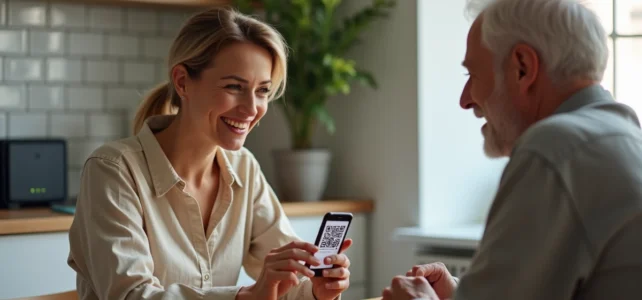
A friend comes over, pulls out their phone, and asks you for the wifi code. You turn the Bbox around, decipher the long string of characters stuck under the device, and dictate it letter by letter. Classic. The problem isn’t the sharing itself, it’s what happens afterward: this password circulates, remains stored on devices you don’t control, and sometimes ends up in a screenshot sent in a group chat.
Guest wifi network on Bbox: the first barrier to activate
Most articles on the subject list sharing methods (QR code, NFC, voice dictation). Before getting there, there’s a setting that changes everything: the guest wifi network separates your devices from those of your friends.
Related reading : Tips for Choosing Your First Pet: What to Consider?
In practical terms, when you activate the guest network from your Bbox’s administration interface, you create a second network with its own name (SSID) and its own password. Your visitors can access the internet, but not your printer, shared drives, or connected cameras.
To access it, type the address of the Bbox interface in your browser (usually 192.168.1.254). Go to the Wi-Fi section, then look for the “Guest Network” or “Guest Wi-Fi” tab. Activate it, choose a distinct name (for example “Bbox-Guests”), and set a dedicated password. You can then share the Bbox wifi code securely without exposing your main network.
Recommended read : Enhancing Your Property Value: Investment Tips for Homeowners
The advantage of the guest password: you can change it after each visit without disrupting your own devices. Your computer, television, and speakers remain connected to the main network, whose password stays the same.
WPA3 encryption on Bbox: check the setting in the interface
You may have heard about WPA3 without knowing exactly what it changes. In brief: it’s the latest encryption protocol for wifi. It makes the connection harder to intercept, even if someone picks up your signal from the street.
Bboxes compatible with Wi-Fi 6 delivered since 2024 support WPA3. According to user feedback on the official Bouygues Telecom forum, WPA3 mode is not always enabled by default. Some boxes come configured in “WPA2/WPA3 mixed” mode, or even in WPA2 only.
To check, go back to the administration interface of your Bbox. In the advanced Wi-Fi settings, look for the security type. If you see “WPA2” only, switch to “WPA3-Personal” or at least to mixed mode. Mixed mode allows older devices (that do not support WPA3) to continue connecting.
When mixed mode causes problems
Some connected devices (old speakers, old wifi printers) refuse to connect in WPA3. If this is your case, keep mixed mode on the main network and enable strict WPA3 on the guest network. Your friends usually use recent smartphones that are WPA3 compatible.
Bbox wifi QR code: share without dictating the password
Dictating a twenty-character password with uppercase letters, numbers, and symbols is a source of errors. The wifi QR code solves this problem in a second: your guest scans the code with their phone’s camera, and the connection is established automatically.
You can generate this QR code in two ways:
- From a recent Android smartphone: go to Settings, then Wi-Fi, select your guest network, and tap “Share.” A QR code appears on the screen, ready to be scanned.
- From an iPhone running iOS 11 or newer: native sharing works between nearby Apple devices. For guests on Android, use a free online wifi QR code generator (type “wifi qr code generator” in your browser).
- From the Bbox interface itself: some recent models offer a QR code directly in the Wi-Fi section of the administration interface.
Generate the QR code from the guest network, not the main network. This is a point that many forget. If you print a QR code linked to your main network and display it in your living room, anyone who scans it gains access to your entire home network.
The trap of the visible QR code in short-term rentals
ANSSI, in its note on good digital security practices for individuals (updated October 2024), warns against visible passwords, including on labels or posters. If you rent your accommodation on a platform, ensure that the wifi QR code does not appear in the listing photos. A malicious visitor could retrieve the SSID and password from the photo, without even having booked.
Bbox wifi password: mistakes that weaken your network
Changing the default password of the Bbox is a widely repeated piece of advice, and rightly so. The factory password is on a label stuck under the box. Anyone who has been to your home could have noted it or photographed it.
But a good password is not enough if you make these common mistakes:
- Using the same password for the main network and the guest network. If one leaks, the other is compromised.
- Leaving the default network name (SSID), which indicates the model of your box. An attacker then knows what vulnerabilities to look for.
- Never changing the guest password after a party or stay. A temporary guest password should be renewed after each use.
For the main network, choose a passphrase: three or four unrelated words, separated by a special character. “Radish*Light*Mosquito” is much easier to remember than “Xk7$2pLm” and remains very difficult to guess by brute force.
Sharing wifi with your friends doesn’t require any special technical skills. Guest network activated, WPA3 encryption checked, QR code generated on the right network: these three settings cover the vast majority of situations. The longest part is connecting to the Bbox interface for the first time. After that, everything can be managed in a few clicks.