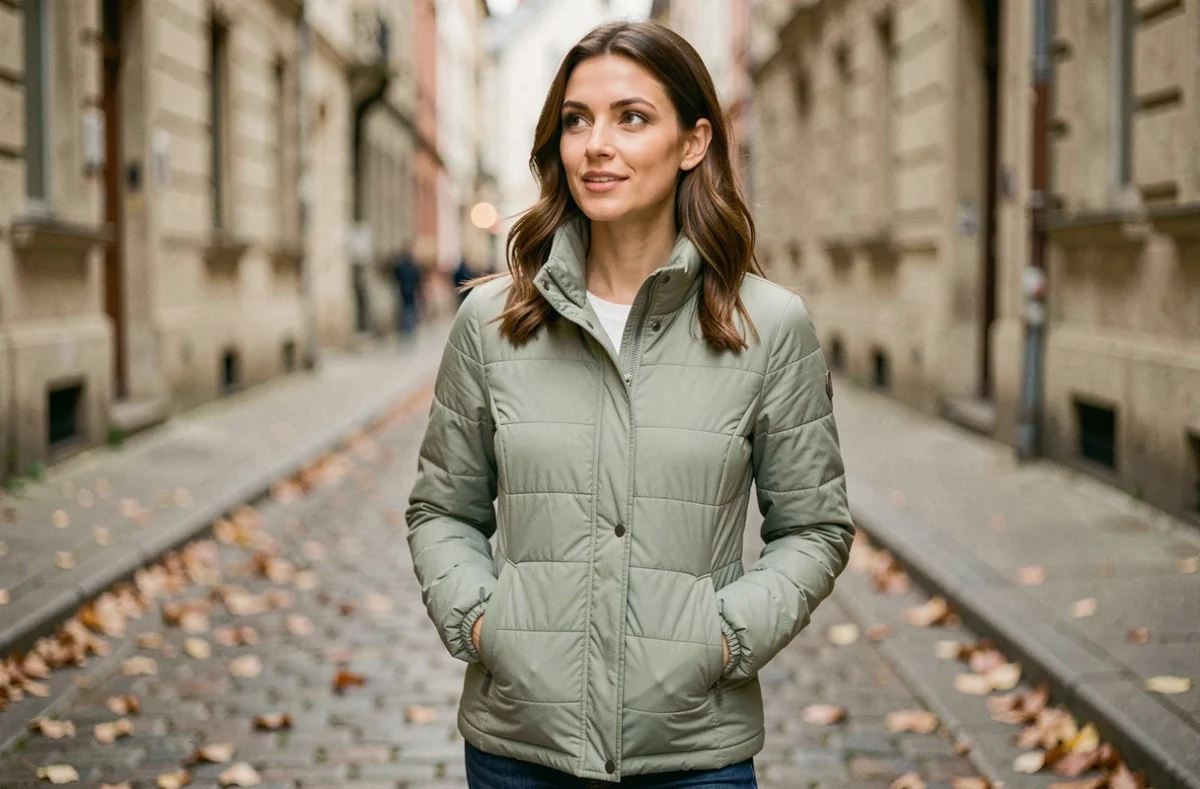
On a a November morning where the thermometer flirts with zero, we put on a lightweight down jacket over a thin sweater before heading out. Two minutes outside is enough to know if the choice was the right one. The lightweight down jacket for women plays the role of a decisive thermal layer, the one that shifts an outfit from shivering to comfort without adding bulk. However, it is essential to understand what distinguishes a reliable model from a disappointing purchase.
Down or synthetic filling: what really changes based on usage context
Natural down offers an excellent warmth-to-weight ratio, provided it is used in dry air, without prolonged contact with moisture, and stored carefully. As soon as we step outside this framework, the situation reverses.
Synthetic filling retains its insulating properties even when wet. For urban use in the rain, a bike ride, or a hike where sweat accumulates, synthetic remains reliable when down collapses. Feedback on this point varies by brand, but the physics of the material does not lie: a synthetic fiber does not clump when it comes into contact with water.
Natural down, measured in cuin (cubic inches), indicates its loft power. The higher the value, the more air the down traps, and the better the insulation is for minimal weight. To know how to choose a lightweight down jacket for women suitable for outings, one should first look at this parameter before considering the brand or color.
Down for dry cold and the mountains, synthetic for humidity and urban versatility. This choice conditions everything else.
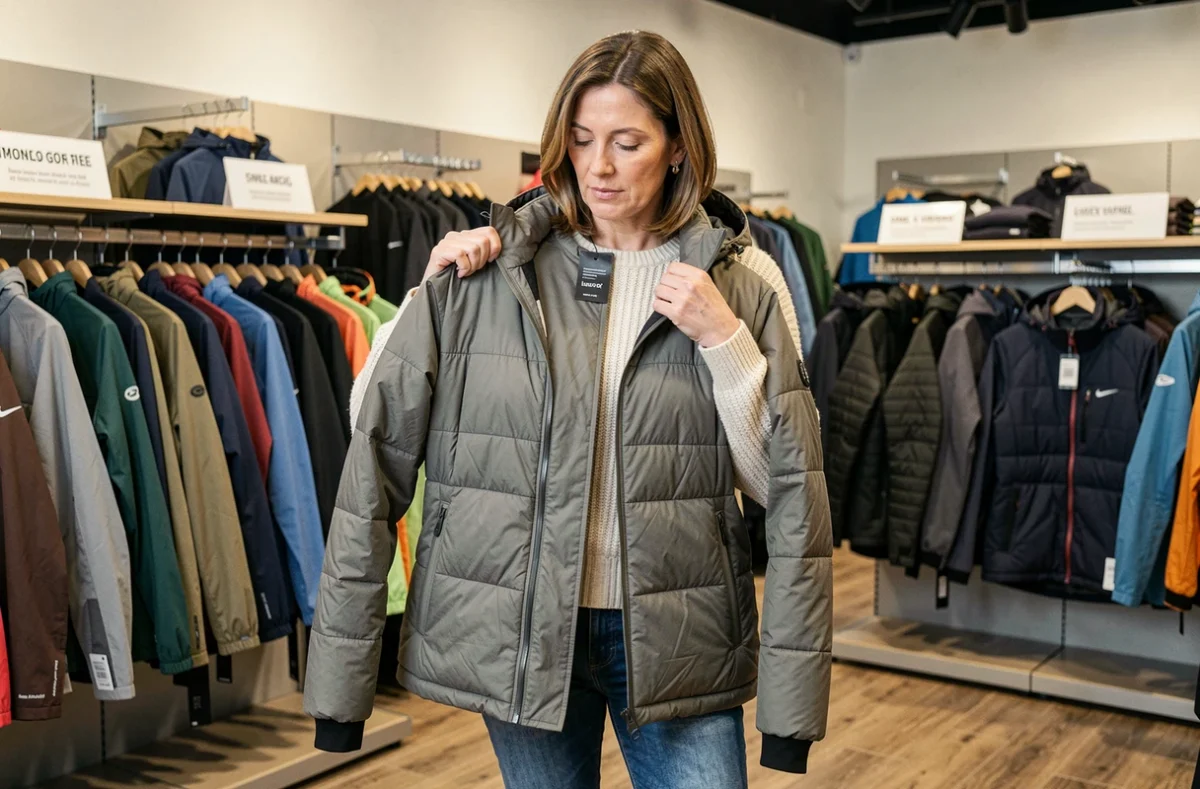
Water repellency without PFAS: a requirement to check on the label
The water-repellent treatment of a down jacket prevents water from penetrating the outer fabric. For years, this performance relied on fluorinated compounds (PFAS), which are now criticized for their persistence in the environment and potential toxicity.
Look for the mention “PFAS-free” or “fluorine-free water repellency” on the label or product sheet; it is no longer just a militant reflex, but a concrete precaution. European regulations foresee an extension of the ban to all textiles by 2030. Anticipating this shift also means avoiding investing in a down jacket whose surface treatment will be obsolete in a few seasons.
Several outdoor brands already offer alternatives based on wax or water-based treatments. The water-repellent performance decreases slightly compared to older fluorinated formulas, but it is sufficient for short showers and daily use.
Repairability and lifespan of a women’s lightweight down jacket
A down jacket is often discarded due to a broken zipper, not worn filling. The European regulation on the eco-design of durable products, adopted in July 2024, places clothing among the priority categories. It paves the way for requirements on lifespan, repairability, and recyclability.
In practical terms, before buying, one can already apply this checklist:
- Quality of zippers: a YKK zipper or equivalent can be easily replaced by a tailor, while an unbranded zipper is much less so
- Boxed or through seams: through seams create cold bridges at junctions, while boxed seams keep the filling in place without perforating both sides of the fabric
- Availability of spare parts: some brands sell repair kits (iron-on patches, zipper sliders) directly on their site
A lightweight down jacket that can have its closure replaced or a tear repaired lasts several more winters. The real cost is calculated over the winter, not at the time of purchase.
Fit and adjustment: adapting the down jacket to its actual use
A down jacket that is too fitted compresses the filling and reduces its insulating power. Too loose, it allows cold air to circulate from below and at the wrists. The correct fit leaves room for a sweater without squashing the volume of the filling.
For use as a mid-layer under a waterproof jacket (hiking, mountaineering), one chooses a close-fitting cut, without a hood, that easily slips under a shell. For outdoor wear in the city, a slightly longer cut better protects the lower back, and an integrated hood avoids the need for multiple accessories.
Hood or high collar
The hood adds weight and volume when packed. If one is already wearing a beanie or if the down jacket serves as a base layer, a high collar is sufficient and simplifies layering. However, for a down jacket worn alone in windy conditions, the hood cuts off cooling at the nape of the neck, an area where heat loss is significant.
Compressibility and packing in a bag
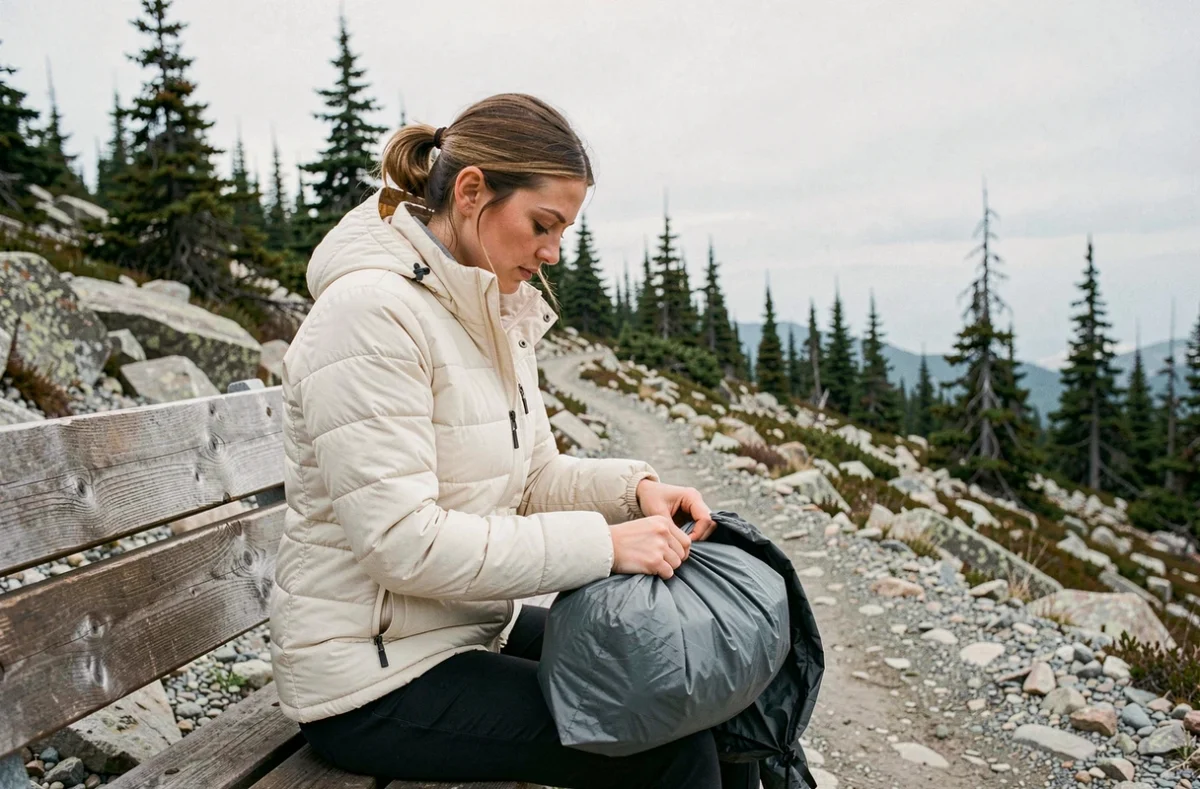
A lightweight down jacket that compresses into its own pocket or an integrated storage bag takes up the space of a water bottle in a backpack. This is the criterion that makes the difference for travel or hiking when every liter of volume counts. One should check that the outer fabric can withstand repeated compressions without the filling losing its loft over time.
Care for a lightweight down jacket: mistakes that ruin insulation
Machine washing is possible, but at low temperature, on a delicate cycle, with a specific detergent without fabric softener. Fabric softener leaves a film on the fibers that reduces the loft power of down and the breathability of synthetic materials.
- Tumble dry on low heat with two or three clean tennis balls to redistribute the filling and prevent clumping
- Never store a compressed down jacket for an extended period: the filling loses its ability to loft if kept compressed for weeks
- Hang the down jacket on a wide hanger in a ventilated closet between seasons, not in its compression bag
Proper spaced maintenance (two to three washes per season of intensive use) preserves thermal performance much longer than frequent poorly executed washes.
Choosing a lightweight down jacket boils down to three considerations: filling suitable for your climate, surface treatment without persistent substances, and construction sturdy enough to be repaired. Color and brand only weigh in after these three criteria.