
A drug is withdrawn from the market after years of use. An algorithm proposes a medical diagnosis without anyone being able to explain its reasoning. These situations raise the same question: how does science produce reliable knowledge, and under what conditions can we trust it? The philosophy of science precisely addresses these types of inquiries, at the intersection of logical rigor and human responsibility.
What the philosophy of science really examines in scientific practice
The discipline does not merely recount the history of discoveries. It analyzes the mechanisms of knowledge production: how does a hypothesis become an accepted theory? What distinguishes a reproducible result from an experimental artifact?
Have you ever noticed that the same scientific fact can be presented differently depending on the source? It is precisely this type of discrepancy that the philosophy of science seeks to understand. It questions the criteria for the validity of knowledge, not just its content.
This approach is distinct from the philosophy of knowledge in a broader sense. The philosophy of knowledge is concerned with the general conditions of human knowledge (perception, memory, reasoning). The philosophy of science, on the other hand, focuses on a specific mode of knowledge: that which comes through controlled observation, experimentation, and modeling. Resources like sciencesphilo.fr allow for exploration of this distinction and the various currents that nourish it.
The term “epistemology,” often used as a synonym, covers a slightly different field depending on the traditions. In France, epistemology mainly refers to the critical study of the sciences. In the English-speaking world, the word refers to the theory of knowledge in general. This nuance in vocabulary is not trivial: it influences how debates are structured in universities and specialized journals.
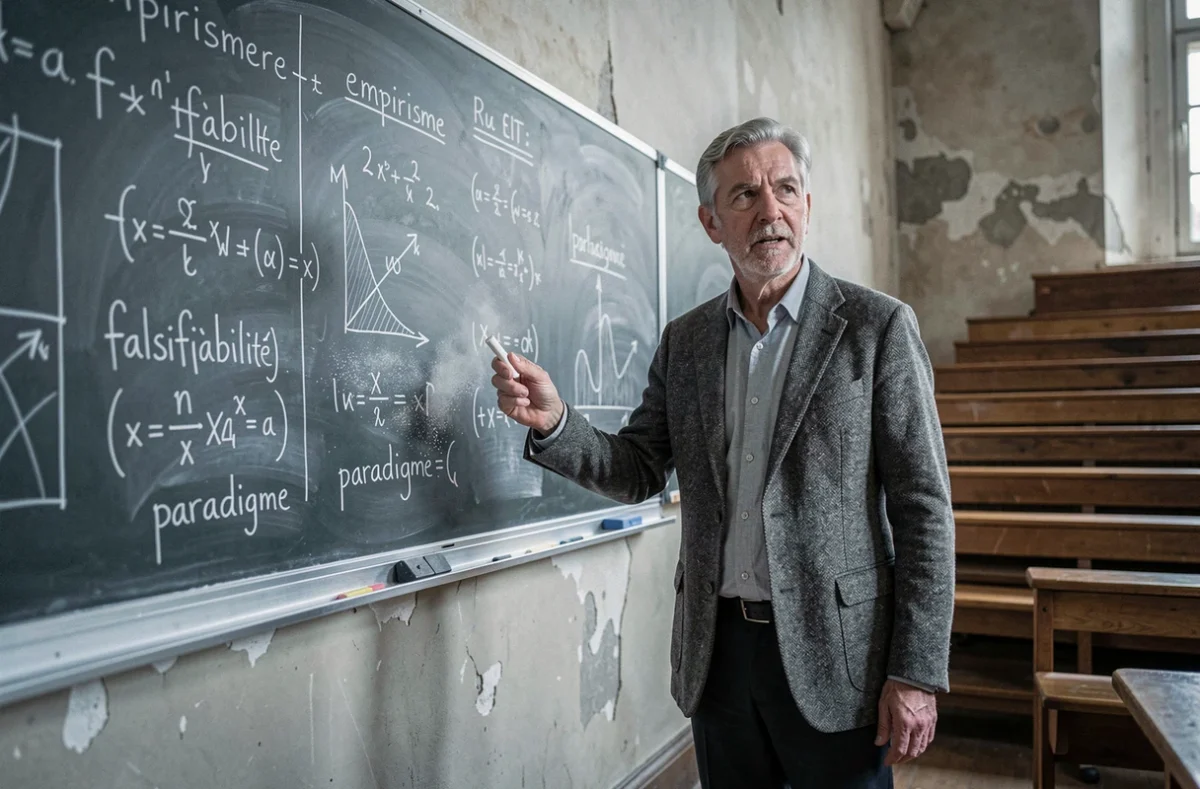
Falsification, paradigms, and induction: three methods that structure debates
To understand current discussions, one must know three approaches that have marked the discipline. Each proposes a different criterion for evaluating what counts as “science.”
- Induction involves deriving general laws from repeated observations. Observing a thousand white swans leads to formulating “all swans are white.” The problem: a single black swan is enough to invalidate the rule, which weakens the approach.
- Falsification, defended by Karl Popper, reverses the logic. A theory is scientific only if it can, in principle, be refuted by an experiment. This criterion has allowed for a clear boundary between science and pseudoscience, even though researchers have shown that daily practice is more nuanced.
- Paradigms, a concept forged by Thomas Kuhn, describe the dominant theoretical frameworks at a given time. Science does not progress linearly: it goes through periods of “normal science” followed by crises and revolutions, when one paradigm replaces another.
These three approaches are not mutually exclusive. A physicist may use induction daily, adhere to the criterion of falsification to evaluate their hypotheses, and recognize that their discipline operates within a given paradigm.
Artificial intelligence and the philosophy of science: a recent battleground
AI is redefining several classic questions of the discipline. Systems have predicted protein structures, proposed equations from raw observations, and demonstrated geometric theorems. These results reignite an old debate: does a result obtained by an opaque model constitute scientific knowledge?
The issue lies in justification. In science, knowing a result is not enough: one must be able to explain why it is true. When a neural network provides an accurate prediction without anyone being able to trace its reasoning, the criterion of justification falters.
The opacity of AI systems raises the question of reliability in a way other than through reproducibility. A researcher may reproduce the result but not the intellectual path that leads to it. For some philosophers, this challenges scientific realism: can we assert that an opaque model teaches us something about non-directly observable phenomena?
The European regulation on AI (EU 2024/1689) illustrates the political dimension of these questions. Its article 2(8) excludes certain research and development activities from its scope before market release. This exclusion remains limited: it does not cover real-world testing or compliance with other Union rules. The boundary between research and deployment becomes as much a philosophical issue as a legal one.

Scientific integrity and public trust: the ethical side of the discipline
The philosophy of science does not stop at laboratories. It also examines the conditions under which knowledge circulates and transforms into public decision-making.
Scientific integrity is part of these questions. Fraud, publication bias, and conflicts of interest undermine trust in results. Several research institutions have strengthened their integrity policies in recent years, distinguishing deliberate misconduct from unintentional methodological errors.
Why does this distinction matter? Because a policy that conflates the two risks either trivializing fraud or discouraging intellectual risk-taking. The philosophy of science helps to formulate these distinctions precisely, relying on logical criteria rather than solely on the public’s emotional reaction.
Another aspect concerns scientific communication. When a provisional result is presented as certainty in the media, it is often because the difference between correlation and causation, between hypothesis and validated theory, has not been explained. Understanding these nuances is part of basic scientific literacy.
The philosophy of science offers a vocabulary and tools to think about the reliability of knowledge beyond intuition. In the face of opaque systems, massive publications, and political decisions that invoke “science,” this analytical capacity has never been more in demand. The work of philosophers of science, long confined to university departments, now intersects with very concrete concerns, from AI regulation to crisis management.